Post Page Advertisement [Top]

 Prime Minister of Bhutan and my younger brother, Deputy Prime Minister of Fiji, Bharat's Minister of Cooperation Amit Shah, President of the International Cooperative Alliance, representatives of the United Nations, all associates connected to the Cooperative World gathered here from across the globe, ladies and gentlemen, 

As I welcome you all today, I do so not alone, and indeed, I cannot do it alone. On behalf of millions of farmers in Bharat, millions of livestock rearers, Bharat's fishermen, over 8 lakhs cooperative institutions, 10 crore women associated with self-help groups, and the youth of Bharat who are connecting cooperatives with technology, I welcome you to Bharat. 

For the first time, the Global Conference of the International Cooperative Alliance is being held in Bharat. At present, we are giving a new dimension to the cooperative movement in Bharat. I am confident that through this conference, we will gain essential insights for Bharat's future cooperative journey, and at the same time, Bharat’s experiences will provide the global cooperative movement with new tools and new spirit for the 21st century. I also extend my heartfelt congratulations to the United Nations for declaring 2025 as the International Year of Cooperatives. 

Friends, 

Cooperatives are a model for the world, but for Bharat, they are the foundation of our culture and a way of life. Our Vedas say, सं गच्छध्वं सं वदध्वं — that is, let us walk together, let us speak in harmony. Our Upanishads state, सर्वे संतु सुखिन: — may everyone be happy. Even in our prayers, coexistence has been a central theme. ‘Sangh’ (Unity) and ‘Sah’ (Cooperation) are the fundamental elements of Indian life. This is also the basis of our family system. And it is precisely this essence that lies at the core of cooperatives. Indian civilization has flourished with this spirit of cooperation. 

Friends, 

Our freedom movement was also inspired by cooperatives. They not only contributed to economic empowerment but also provided a collective platform for freedom fighters. Mahatma Gandhi's concept of Gram Swaraj (village self-rule) infused new energy into community participation. He initiated a new movement in areas like khadi and village industries through cooperatives. Today, khadi and village industries, supported by our cooperatives, have surpassed even some of the biggest brands.  During the same period, Sardar Patel united farmers and gave a new direction to the freedom movement through milk cooperatives. Born out of the freedom revolution, Amul is today one of the top global food brands. We can say that cooperatives have journeyed from ideas to movements, from movements to revolutions, and from revolutions to empowerment in Bharat. 

Friends, 

Today, we are combining the power of the government and cooperatives to make Bharat a developed nation. We are following the mantra of ‘Sahkar Se Samriddhi’ (prosperity through cooperation). Bharat today has over 8 lakhs cooperative societies, meaning that one out of every four cooperatives in the world is in Bharat. Not only in numbers but also in scope, these cooperatives are vast and diverse. Around 98% of rural Bharat is covered by cooperatives. Approximately 300 million people—one out of every five in the world and one out of every five Indians—are associated with the cooperative sector.  Cooperatives play a significant role in sectors such as sugar, fertilizers, fisheries, and milk production.

Over the decades, Bharat has also seen significant growth in urban cooperative banking and housing cooperatives. Today, there are nearly 200,000 housing cooperative societies in Bharat.  In recent years, we have strengthened the cooperative banking sector through reforms. Today, cooperative banks across the country hold deposits worth 12 lakh crore rupees (12 trillion rupees). To further strengthen and build trust in these banks, our government has brought about several reforms. Earlier, these banks were outside the purview of the Reserve Bank of India (RBI), but now they have been brought under the RBI's ambit. We have also increased the insurance coverage on deposits in these banks to 5 lakh rupees per depositor. Digital banking has been expanded in cooperative banks. These efforts have made Bharat’s cooperative banks more competitive and transparent than ever before.

Friends, 

Bharat envisions a significant role for cooperatives in its future growth. Therefore, in recent years, we have worked to transform the entire cooperative ecosystem. Bharat has undertaken numerous reforms in this sector. Our goal is to make cooperative societies multipurpose. To achieve this, the Government of Bharat has established a separate Ministry of Cooperation. New model bylaws have been introduced to make these societies multipurpose. We have integrated cooperative societies with an IT-enabled ecosystem and connected them with district and state-level cooperative banking institutions. Today, these societies are running local solution centres for farmers in Bharat. These cooperative societies are operating petrol and diesel retail outlets, managing water systems in many villages, and installing solar panels. Under the Waste to Energy initiative, these cooperative societies are also contributing to the GOBARdhan scheme. Moreover, cooperative societies are now providing digital services in villages as Common Service Centres. Our effort is to strengthen these cooperative societies so that their members can increase their income. 

Friends, 

We are now forming multipurpose cooperative societies in 200,000 villages that currently lack such organizations. We are expanding cooperatives in both the manufacturing and service sectors. Bharat is working on the world's largest grain storage scheme in the cooperative sector. These cooperatives are executing the plan to build warehouses across the country where farmers can store their crops. This initiative will particularly benefit small farmers. 

Friends, 

We are organising our small farmers into Farmer Producer Organisations (FPOs). The government is providing necessary financial support to these FPOs of small farmers, and about 9,000 of these FPOs have already started operations. Our aim is to establish a strong supply and value chain for our farm cooperatives, connecting farms to kitchens and markets. To achieve this, we are leveraging modern technology. Through platforms like the Open Network for Digital Commerce (ONDC), we are offering cooperatives a new medium to sell their products. This platform enables cooperatives to deliver products directly to consumers at minimal costs. The digital Government e-Marketplace (GeM) platform created by the government is also proving highly beneficial for cooperative societies. 

Friends, 

In this century, women's participation will be a major factor in global growth. Societies that provide greater opportunities for women will grow faster. Bharat is currently witnessing an era of Women-Led Development, and we are focusing heavily on this. In the cooperative sector, women play a significant role, constituting more than 60% of the sector. Numerous women-led cooperatives have become a source of strength in this sector. 

Friends, 

Our effort is to increase women's participation in cooperative management. To this end, we have amended the Multi-State Cooperative Societies Act. It is now mandatory to have women directors on the boards of Multi-State Cooperative Societies. Furthermore, to make societies more inclusive, reservations have been introduced for marginalized sections. 

Friends, 

You may have also heard about the large movement of self-help groups (SHGs) in Bharat. This is a significant initiative towards Women Empowerment through Women Participation. Today, 10 crore or 100 million women in Bharat are members of self-help groups. Over the past decade, these SHGs have received loans worth 9 lakh crore rupees (9 trillion rupees) at low interest rates from the government. These self-help groups have generated substantial wealth in villages. This can create a model for women empowerment that many countries can emulate. 

Friends, 

The 21st century is the time to collectively decide the direction of the global cooperative movement. We must think about a collaborative financial model that makes cooperative financing simpler and more transparent. Pooling financial resources is crucial to support smaller and economically weaker cooperatives. Shared financial platforms could fund large projects and provide loans to cooperatives. Our cooperatives can also contribute to improving supply chains through participation in procurement, production, and distribution. 

Friends, 

There is another topic that requires deliberation: Can we establish large global financial institutions to finance cooperatives worldwide? While the International Cooperative Alliance (ICA) is playing its role effectively, the future demands that we go beyond this. Current global conditions present a significant opportunity for the cooperative movement. We need to make cooperatives the flag-bearers of integrity and mutual respect globally. To achieve this, we must innovate and strategize our policies. Cooperatives should also adopt the principles of the circular economy to become climate-resilient. Additionally, we must explore ways to encourage start-ups within cooperatives. This also needs deliberation. 

Friends, 

Bharat believes that cooperatives can bring new energy to global cooperation. Particularly for countries in the Global South, where specific growth models are needed, cooperatives can provide critical support. Therefore, we must innovate and create new pathways for international collaboration in cooperatives. I see this conference playing a significant role in achieving that vision. 

Friends, 

Bharat is one of the fastest-growing economies today. Our goal is not just high GDP growth but ensuring that its benefits reach even the poorest of the poor. It is equally important for the world to view growth through a human-centric perspective. Bharat has always prioritized humanity within the country or globally. It was demonstrated during the COVID-19 crisis when we supported resource-deprived countries, many of which were from the Global South, by sharing medicines and vaccines. While economic logic suggested capitalizing on the situation, however, humanity said that was not the correct way. It guided us to choose the path of service, not profit. 

Friends, 

The importance of cooperatives lies not just in their structure or legal framework. These elements can build organisations and facilitate growth and expansion, but the true essence of cooperatives is their spirit. This Cooperative Spirit is the lifeblood of the movement, rooted in the culture of cooperation. Mahatma Gandhi believed that the success of cooperatives lies not in their numbers but in the moral development of their members. With morality, decisions will always align with humanity’s best interests. I am confident that we will continue to strengthen this spirit during the International Year of Cooperatives. Once again, I welcome you all and extend my best wishes. Over the next five days, this summit will discuss numerous topics, and I am confident that the outcome will empower and enrich every section of society and every nation, advancing with the cooperative spirit. With this belief, I wish you all the very best. 

Thank you. 

********

Read more ...

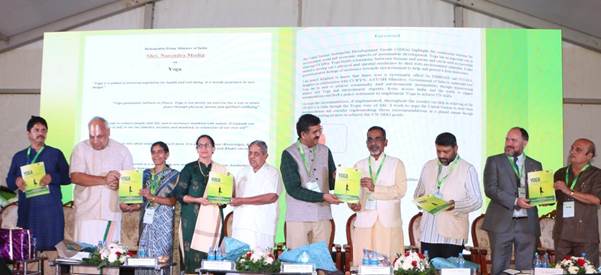
 The 7th Naturopathy Day was celebrated at the Central Research Institute of Yoga and Naturopathy (CRIYN), Nagamangala, under the aegis of the Central Council for Research in Yoga & Naturopathy (CCRYN), Ministry of Ayush. The event drew participation from over 800 doctors, undergraduate and postgraduate scholars from across India, representing states such as Andhra Pradesh, Tamil Nadu, Kerala, Maharashtra, Uttar Pradesh, Rajasthan, Gujarat, and Manipur.

The event was graced by distinguished dignitaries, including, Ms. Kavita Garg, Joint Secretary, Ministry of Ayush, Dr. Raghavendra Rao, Director, CCRYN, Dr. H.R. Nagendra, Chancellor, SVYASA University, Dr.Manjunath N.K., Vice-Chancellor, SVYASA University, Dr.Prashanth Shetty, Member, Governing Board, CCRYN, Sri Cheluvarayaswamy, Minister of Agriculture and MLA, Nagamangala.


In a written message, Union Minister of State (Independent Charge) for Ayush Shri Prataprao Jadhav highlighted naturopathy as a unique system of medicine that promotes health by aligning with nature. He suggested establishing Yoga and Naturopathy Diet Centres (YNDCs) across the nation and assured that the Government of India is actively working towards central legislation for the systems of yoga and naturopathy.

Shri Jadhav emphasized the government’s focus on research and evidence generation, stating, “We are going to create a chain of research and teaching institutes like Central Research Institutes in Yoga and Naturopathy (CRIYN) with 100 to 200 bed hospitals to conduct high-level research across various states.” He noted that two CRIYNs, one at Nagamangala, Karnataka, and another at Jhajjar, Haryana, are already operational. On Ayurveda Day 2024, the Prime Minister laid the foundation stones for new 100-bed CRIYNs in Raipur, Chhattisgarh, and Khorda, Odisha. Plans are underway for similar institutes in Assam, Andhra Pradesh, and Kerala.

Smt. Kavita Garg, Joint Secretary, Ministry of Ayush remarked on the timeless wisdom of naturopathy, saying, “Naturopathy teaches us to eat, drink, act, and live in moderation. It equips us with the art of self-management, enabling us to stay healthy for spiritual pursuits. We must stay in the present and not dwell on the past or future.”

Dr. H.R. Nagendra highlighted the importance of advancing research in yoga and naturopathy, envisioning CRIYNs as global centers of excellence for high-end research.

The event also included the felicitation of winners from the YOGATECH Challenge, which recognized innovative startups blending yoga with modern technology. Selected from over 70 entries, 15 startups across categories such as devices, IT solutions, and props and accessories made it to the finals:NT Solutions won in the Devices category; Yog4Life emerged as the winner in the Solutions category.

The challenge showcased innovations such as AI-driven applications, wearable devices, and advanced yoga accessories, highlighting the transformative power of technology in bringing ancient wellness practices into the modern era.

Role of Yoga in UN SDG Goals, a collaborative book by NIMHANS, SVYASA University, and CCRYN, was released, illustrating yoga’s role in achieving the United Nations Sustainable Development Goals (SDGs). Also, 10 research books on yoga, one on naturopathy, and the inaugural issue of the Indian Journal of Yoga and Naturopathy, published by Wolters Kluwerwere also launched.

The event served as a prelude to the upcoming International Conference on Naturopathy, scheduled from November 18-19, 2024, where global experts will explore new frontiers in holistic health and wellness.


****

Read more ...

 A retreat is a gathering that typically takes place in a secluded or tranquil setting, often away from the usual workplace or busy urban environments. This type of event is focused on allowing participants to disconnect from their regular routines, engage deeply with specific themes or issues, and foster meaningful interactions amongst each other. Retreats are commonly used within corporate, educational, religious, and wellness contexts, each serving different purposes but generally aiming to rejuvenate participants and inspire new thoughts or behaviors.

Structure of a Retreat

The structure of a retreat can vary widely depending on its objectives and the audience it serves. Here are some typical elements that define most retreats:

  1. Location: Retreats are often held in settings close to nature, such as mountain lodges, beach resorts, or rural cottages, providing a peaceful environment conducive to relaxation and reflection.

  2. Duration: They typically last anywhere from a weekend to a week. The duration allows participants to deeply immerse themselves in the experience without the distractions of daily life.

  3. Activities: Depending on the focus of the retreat, activities can range from workshops, group discussions, and team-building exercises to more introspective practices like meditation, yoga, and guided reflections.

  4. Free Time: Adequate free time is usually built into the schedule to allow participants to relax, explore the surroundings, or engage informally with one another, which can help foster personal connections and mutual understanding.

  5. Facilitated Sessions: Most retreats include sessions facilitated by experts who guide participants through the planned activities, ensuring that the objectives of the retreat are met.

  6. Goal Setting and Reflection: Particularly in corporate or educational retreats, sessions dedicated to setting personal or group goals and reflecting on them are common, aiming to integrate the experiences of the retreat into participants’ personal or professional lives.

Objectives of a Retreat

Retreats are organized with various objectives in mind, such as:

  • Team Building and Leadership Development: In corporate settings, retreats often focus on enhancing team cohesion and leadership skills through structured activities that encourage collaboration and communication.

  • Educational Purposes: Academic retreats may aim to delve into specific scholarly topics, away from the distractions of campus life, fostering deeper understanding and innovation.

  • Spiritual or Religious Renewal: Many retreats serve to nurture the spiritual lives of participants, offering a space for prayer, contemplation, and religious teachings.

  • Health and Wellness: Wellness retreats focus on improving physical and mental health through activities such as yoga, meditation, and health-focused workshops.

Benefits of a Retreat

Retreats offer numerous benefits:

  • Rejuvenation: By stepping away from daily stresses, participants can relax and rejuvenate, which is beneficial for mental and physical health.
  • Enhanced Focus: The secluded environment helps individuals focus intensely on specific topics or personal development goals.
  • Strengthened Relationships: Sharing the retreat experience can foster stronger bonds among participants, be they colleagues, peers, or fellow community members.
  • New Perspectives: Immersion in a different setting with a variety of activities can provide new insights and ways of thinking that impact participants’ personal and professional lives.

Challenges of a Retreat

Despite their advantages, retreats can present challenges:

  • Accessibility and Inclusivity: The cost and location of retreats may limit who can participate, potentially excluding those with limited mobility or financial constraints.
  • Integration of Experience: Translating the peace or insights gained during a retreat back into everyday life can be difficult for participants.
  • Diversity of Expectations: Ensuring that the activities and outcomes satisfy all participants’ expectations can be challenging due to diverse needs and interests.

In conclusion, retreats are powerful experiences that can lead to profound personal and professional growth. When well-planned and thoughtfully executed, they provide an invaluable opportunity for participants to step back, reflect, and engage in meaningful ways that enrich their lives and work.

Read more ...

 A congress is a large formal gathering of individuals, often from various locations and fields, who convene to discuss shared interests, conduct organizational business, or deliberate on significant issues within a particular domain, such as political, scientific, or academic areas. Unlike smaller, more focused gatherings like workshops or seminars, a congress typically involves a broader scope of topics and a wider, often international, attendance. It serves as a platform for policy-making, extensive networking, and substantial exchange of information across a large group of participants.

Structure of a Congress

The structure of a congress can be quite complex, reflecting its expansive scope and the diverse interests of its participants. Key elements typically include:

  1. Plenary Sessions: These sessions are designed for all participants and feature keynotes and major speeches by leading experts, dignitaries, or notable figures in the field. These sessions set the tone and often outline the broader themes of the congress.

  2. Parallel Sessions: Given the broad array of topics, congresses often feature multiple parallel tracks that allow participants to choose from a variety of sessions that best fit their interests. These sessions can include presentations, panel discussions, and debates.

  3. Workshops and Symposia: These smaller, more specialized meetings within a congress focus on specific niche areas. They provide opportunities for more detailed discussions and closer interaction among attendees.

  4. Exhibitions: Many congresses include exhibitions where companies, organizations, and institutions can display their latest products, services, or research findings. This setup facilitates direct engagement between exhibitors and congress participants.

  5. Networking Events: Formal and informal networking events are key components of a congress, providing attendees with opportunities to meet peers, experts, and potential collaborators in a less structured environment.

  6. Committee Meetings and Decision-Making Sessions: In many professional and scientific congresses, committees meet to make decisions regarding organizational matters, professional standards, or future congress locations and themes.

  7. Social and Cultural Programs: These programs are often included to showcase the host city or country’s culture and to provide entertainment for attendees, enriching the overall experience and fostering goodwill among participants.

Objectives of a Congress

The objectives of a congress are varied and depend largely on its focus and audience, but they generally include:

  • Information Exchange: To facilitate the exchange of up-to-date information and new research findings across a wide range of topics.
  • Networking and Collaboration: To provide a platform for building networks and fostering collaboration across geographical and disciplinary boundaries.
  • Decision Making and Policy Formation: To deliberate on and make decisions regarding key issues affecting the field or profession.
  • Professional Development: To contribute to the professional development of attendees through workshops, seminars, and discussions on the latest trends and challenges in the field.

Benefits of a Congress

The benefits of organizing or attending a congress are significant:

  • Learning Opportunities: Attendees can learn about the latest developments, new technologies, or advanced research in their field.
  • Influencing Industry or Academic Trends: Congresses often set the agenda for future research and development and help in shaping policy within the field.
  • Cultural Exchange: International congresses bring together participants from around the world, offering unique opportunities for cultural exchange and mutual understanding.

Challenges of a Congress

However, organizing and participating in a congress can also present challenges:

  • Logistical Complexity: The size and scope of congresses make them complex to organize, requiring significant logistical planning and resources.
  • Cost: Attending or hosting a congress can be expensive, considering travel, accommodation, venue, and other logistics.
  • Overwhelming Scope: With so much information and so many events, participants can sometimes find it challenging to navigate the congress or choose between concurrent sessions.

In conclusion, a congress is a crucial forum for knowledge exchange, networking, and decision-making within various fields. Its success depends on careful planning, a clear understanding of its objectives, and effective management of its diverse activities and large-scale logistics.

Read more ...

Latest Posts

5/recent/post-list